
Children's wild bees and Zeidler garden
 Ecological Project
Wannseestr. 23
14532 Stahnsdorf
Germany
From wasteland to a children's wild bee and tree garden
The Waldorf 100 project "Bees & Trees" in the Waldorf kindergarten in Hochwald
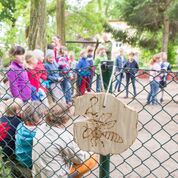
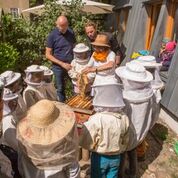
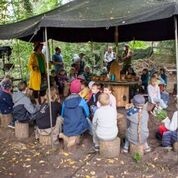
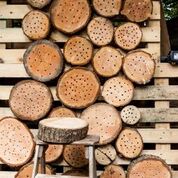
The Waldorf kindergarten in Hochwald has had bees for ten years and works on them together with the children throughout Year. And as one or the other may also know, there was a completely uncultivated piece of forest at the Stahnsdorf site next to the property that was already in use. Now the fallow land has changed a lot and is revived as a children's, wild bee and Zeidler garden of our Waldorf kindergarten. The Waldorf 100 Project Bees & Trees can be seen and experienced on our "wild" property. Between tall pines, locust trees and linden trees, two honey bee colonies hum in a log hive and in a Weisseseifen hanging basket. 47 tree discs as insect hotels are waiting for the wild bees to move in, because the table is ready, the bee pasture is blooming.
The first "Bee Day": students, royal children, parents and teachers as a project team</ strong>
It all started with a very special project in June 2019, just before the summer holidays: for three days, we had 32 second-grade students from the Kleinmachnow Waldorf School and 15 royal children (kindergarten children about to start school) , ten parents of the students and two teachers let them experience intimacy, care, joy of discovery in connection with nature and with us children and bee educators. Every day we received all children and parents under the roof of our yurt. We greeted each other with singing and powerfully spoken bee sayings. For the kindergarten children there was the following saying:
What the bees give us every day
Are miracles when we think about it;
They bring the gifts of flowers into the home,
make wax and honey out of it.
The greatest miracle, don't forget,</ em>
Given to us in both:
In wax it shines as golden light,
in honey it gives strength in life.
(Horneber, 2019)
and this for the school children:
We build, we build the honeycomb, the house,
A little flower peeks out of each one.
We build, we build according to a picture,
the flower shines from each one te mild.
From tip to tip we draw the wall,
The corner, the angle, the face, the edge.
We draw and build, then we fill in,
The honey will probably be in the comb.
(transmitted)
We children and bee educators always had a theoretical part. From the origin of beekeeping, to the peculiarity and variety of insects, to the craft of the beekeeper and a lot about the honey bee itself. The children then got the typical kindergarten breakfast with rice pudding on Mondays, small rolls on Tuesdays and millet on Wednesdays. They were allowed to taste the gifts of the bees, smoke the beekeeper's pipe, see a wasp's nest from the inside, chew honeycomb (the bees' chewing gum), discover the difference between an empty and a full honeycomb and experience community, cohesion and the joy of the bees full of compassion and curiosity .
DIE ZEIDLEREI
The ZEIDLEREI is an old guild that has been practiced in Germany since the Middle Ages and has now almost disappeared. It is, so to speak, the original form of beekeeping in Europe, in which the beekeeper did not domesticate the bees at home, as we know it from classic beekeeping today, but practiced his craft in the forest. To do this, he dug holes and notches in trees so that the bee colonies could settle here, and thus managed them in their natural environment. Even if beekeeping in boxes, so-called beehives, brought some comfort when harvesting honey, for example, this form of natural and appropriate beekeeping has come as close as it is increasingly demanded today.
The five areas of responsibility of our bee day:
At the beginning we divided the children into five groups (ZEIDLER GROUP, FIRE GROUP, BEE GROUP, HONEY GROUP AND TREE BLOSSOM GROUP). In these groups, the children were accompanied and instructed by their parents, teachers and educators every day in five areas of responsibility.
On the first day we worked for nature.
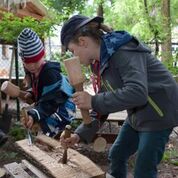
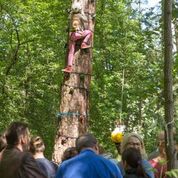
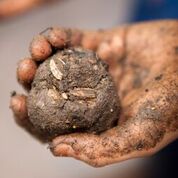
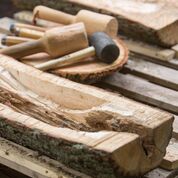
The children and parents planted flowers, drilled insect hotels, made log hives, prepared flower seed balls and climbed, secured and professionally accompanied, like the Zeidler, onto our tallest pine.
On the second day we got to know the craft of the beekeeper.
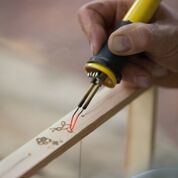
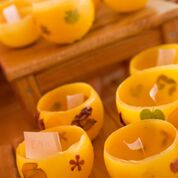
The children and parents learned to assemble the frames (the scaffolding in which the bees build their honeycomb), to wire and to solder in the foundations (the starting wax plate in the frame), everyone was allowed a frame Write your own name on it with the Brennpeter soldering iron. We also cleaned and refurbished frames, carved honey dippers, built a display case and honey rooms for our economic people and made beeswax lanterns in our wax workshop. At the end of the day, we children and bee educators enlivened the showcase in the presence of everyone with two brood combs and plenty of bees. The schoolchildren took this showcase to their classroom.
On the third day, the beehive as a living organism was the focus of the day.
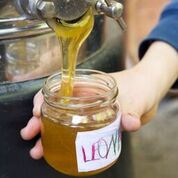
The children experienced in our in-house bee and herb garden the beehive from the inside, they harvested honey, uncovered the honeycombs and threw them out. The children were allowed to paint their own label and fill a jar of honey, paint the self-made honey chambers and artistically design large carpenter bees. They also baked many, many bee stings in our honey kitchen for the end of the year.
Now only one thing was missing, the introduction of the lesson books. Her first lesson of the now opened bee epoch took place in the rooms of the kindergarten. Of course, the teachers took care of that. During this time, the parents prepared the graduation, at which the children showed the parents what had been created, were given their homemade gifts to take home and all enjoyed the bee sting.
The pupils' showcase became the center of the bee epoch. The children experienced the construction of the queen cell (the hatching cell and cradle of the future queen), their hatching and the laying of the eggs after mating. We kept a diary together about what we had experienced and learned. On the day the certificates were handed out, the class invited us educators and sang a bee musical as a thank you. We also got many beautiful self-painted pictures.
Everything described here was documented by two photographers. At this point, thanks should not be missing at all to all parents of the school and educators of our Waldorf kindergarten who were involved.
And so it went on
The bees and honeycombs of the display case have now been drawn into a block hive in the shape of a lighthouse. From here they symbolically fly out into the world. Because that is what we were able to experience ourselves on these "bee days": Our children need beacons for their orientation, namely in the form of adults who are there for them in the truest sense of the word with their attention and their interest in them. And in this context, both the children and the bees are meant - because both are our future.
On the Waldorf 100 celebration on August 31, 2019, we presented this "FUTURE PROJECT" in the Freie Waldorfschule Kleinmachnow.</ p>
Our yurt became the "tent of the future", we developed visions for the future with everyone present, burned them onto the lighthouse on site and sent them out into the world on prepared honeycomb cards with balloons.
So our visions swarmed out like bees and reminded one or the other that ECOLOGY IS WHAT EVERYONE MUST CONTRIBUTE TO THE ART OF KEEPING THE PLANET ALIVE!*
*Horst Kornbacher "Wonder of the World Beehive"
-----------------------------------------
Anke Kunkel is an educator in the Waldorf kindergarten in Hochwald and has been a bee educator for over 15 years alongside her job as a kindergarten teacher. She learned beekeeping from her father.
Julian Goll also works as an educator in the Waldorf kindergarten in Hochwald. He himself spent his school days at the Freie Waldorfschule Kleinmachnow, also keeps bees and is also a passionate tree climber.
 Jetzt zur deutschen Seite wechseln
 Cambiar a la página en español ahora
 Stay on English website
